
Ground Source Heat Pump: Is the Extra Cost Worth It for Your Home?
Last updated:
- The Boiler Upgrade Scheme gives £7,500 towards ground source, same as air source
- Off-grid oil and LPG homes get £9,000 until March 2027
- The DESNZ median fitted cost was £34,630 in July to September 2026
- Ground source made up under 2% of grants paid so far
- Fitting, including the groundworks, is zero-rated for VAT until 31 March 2027
- Homes in England normally need no planning permission to fit one
- Closed and open loops have separate Environment Agency rules
Could an air source heat pump and the Boiler Upgrade Scheme suit your home?
Check If You Qualify- Gas Safe registered engineers
- Company No. 16100301
£7,500
Ground source grant
GOV.UK
£9,000
Off-grid oil or LPG grant
GOV.UK, until March 2027
£34,630
Median fitted cost
DESNZ, Jul to Sep 2026
31 Mar 2027
0% VAT ends
HMRC
What is a ground source heat pump, and how does it heat a house?
A ground source heat pump is a heating system that collects warmth from the ground outside your home and raises it to a temperature useful for radiators, underfloor heating and hot water. It runs on electricity, and it replaces a gas, oil, LPG or electric heating system rather than working alongside one under the grant.
The Department for Energy Security and Net Zero (DESNZ) defines it as a plant that transfers heat "from the ground, including water in the ground or surface water or both" and uses it to heat a liquid for space heating. In plain terms, the system has three parts:
- The ground loop: pipes buried in your garden or land. A fluid runs through them and picks up heat from the ground around it.
- The heat pump unit: it takes the heat from the loop and raises it to a temperature your heating can use.
- The heating side: radiators or underfloor pipes, plus a hot water cylinder, which receive that heat.
The heat comes from the ground rather than the outside air, which is what sets it apart from an air source heat pump.
Trenches, boreholes or open loop: which ground loop fits your plot?
There are four main set-ups, and the Environment Agency rules differ between them:
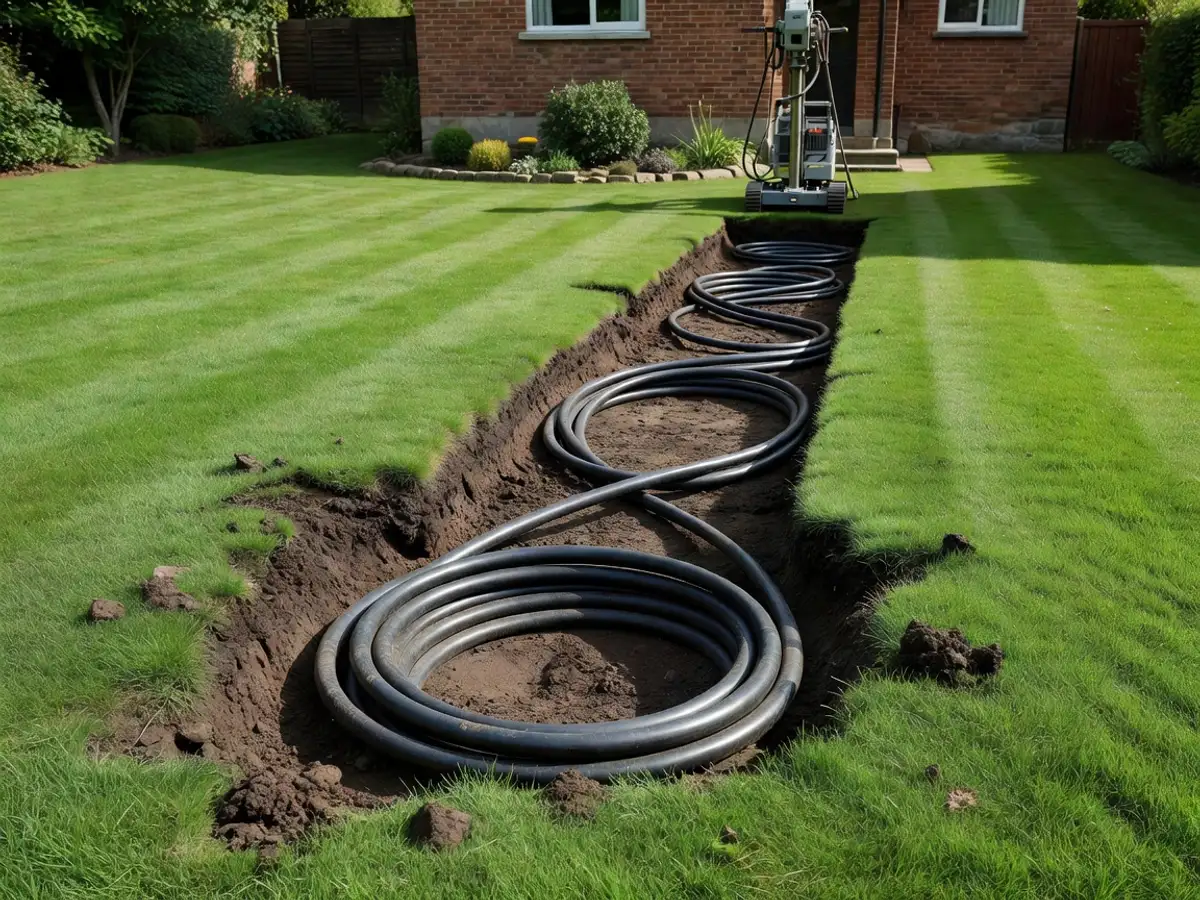
- Horizontal loop in trenches: pipes laid flat in long trenches dug across a garden or field.
- Vertical loop in boreholes: pipes lowered into holes drilled into the ground.
- Open loop: instead of a sealed pipe, the system pumps water up from under the ground (or from a river, lake or canal), takes heat from it and returns it. The Environment Agency treats this as taking water, so permits and licences apply (see the permits section below).
- Shared ground loop: one set of boreholes or trenches serving two or more homes, each with its own heat pump. DESNZ describes it as "a communal system that provides heat to two or more properties using individual GSHPs connected to it."
Horizontal and vertical systems are both closed loops: the Environment Agency guidance says the boreholes or pipework "are fully sealed and have no direct connection with any groundwater."
What does a ground source heat pump cost to put in?
DESNZ puts the median cost of a ground source heat pump at £34,630 for systems paid a grant in July to September 2026, including the grant value. That comes from the Boiler Upgrade Scheme statistics for September 2026, published on 29 October 2026.
The spread is wide, and size explains much of it (DESNZ, July to September 2026):
- Lower quartile cost: £22,348 for ground source
- Median cost: £34,630 for ground source, against £12,826 for air-to-water
- Upper quartile cost: £53,345 for ground source
- Median size: 15 kW ground source, 8 kW air-to-water
One quarter earlier, in April to June 2026, the ground source median was £27,232, and the median system was 10.5 kW. The jump to £34,630 came with a jump to 15 kW systems, and DESNZ notes that "the underlying mix of heat pump sizes can influence the trend in median costs over time." So when you compare quotes, compare systems of a similar size, not one headline average against another.
Example (DESNZ medians, July to September 2026): £34,630 less the £7,500 grant leaves £27,130. For an off-grid home on oil or LPG getting £9,000, it leaves £25,630. Your own figure depends on the loop type and the size of system your home needs.
Do you pay VAT on the groundworks too?
No, not until 31 March 2027. HMRC VAT Notice 708/6 says ground source heat pumps "benefit from the zero rate of VAT", and from 1 February 2024 to 31 March 2027 the relief "also includes preparatory work that is necessary for the installation of a ground source heat pump", meaning the groundworks, or dredging of a body of water, to lay the pipework.
From 1 April 2027 the notice says these installations go back to the reduced rate of 5%. A home planning ground source work around then should check which side of that date the installation falls.
If the remaining cost is the stumbling block, the government's Warm Homes Loan Scheme factsheet (published 27 October 2026) lists loans of up to £35,000 for a ground source heat pump. Our guide to heat pump finance explains how a loan sits alongside the grant.
How much is the ground source heat pump grant, and who can get it?
The Boiler Upgrade Scheme gives £7,500 towards a ground source heat pump, including water source heat pumps and those on shared ground loops. GOV.UK's Apply for the Boiler Upgrade Scheme guidance also says that until March 2027 you can get an extra £1,500, making £9,000, where oil or LPG heats the property and there is no mains gas connection to it.
The scheme is open in England and Wales to owners who are replacing fossil fuel heating. The full eligibility rules are on our heat pump grant page.
Two details are easy to miss. The grant used to be lower for ground source. DESNZ records that on 23 October 2023 it rose "from £5,000 for air-to-water heat pumps and £6,000 for ground source heat pumps to £7,500 for both." And the maximum size for one home is 45kWth, while a shared ground loop can go up to 300kWth.
The grant is not paid to you. Your installer applies for it on the Ofgem website and deducts it from the installation price, so your quotation and invoice already show the lower figure. Ofgem's installer guidance says vouchers for ground source heat pumps are valid for 6 months. Our Boiler Upgrade Scheme guide covers the full process.
Air source vs ground source heat pump: which suits your home?
For most homes, air source is the better fit, because its median fitted cost is just over a third of the ground source figure. Ground source earns its higher price in a narrower set of homes. The DESNZ data shows how lopsided the choice is in practice. Of 96,611 grants paid up to the end of September 2026, 94,545 were for air-to-water heat pumps, 1,603 for ground source heat pumps and 37 for shared ground loop systems.
Ground source tends to make sense where the home has the land for trenches or boreholes and a large heat demand. That second point is why the median ground source system in the cost list above is almost twice the size of the median air source one. Air source is usually the better choice where the plot is small or the budget is tight. If running costs or noise are your main worry, our guides on whether heat pumps are worth it and on heat pump noise and planning go into both.
Not sure ground source is worth it for your home?
Do you need planning permission or a permit to dig a ground loop?
For a house or block of flats in England, planning permission is normally not needed. Class C of the General Permitted Development Order 2015 allows "the installation, alteration or replacement of a microgeneration ground source heat pump within the curtilage of a dwellinghouse or a block of flats", and, unlike the air source class, it lists no conditions for homes. The 0.5 hectare limit on the area dug out applies to non-domestic buildings under Class L, not to homes.
Planning is only half of it. The Environment Agency has its own rules in England, and they depend on the loop type.
Closed loop (trenches or boreholes): for systems installed on or after 2 October 2023, the Environment Agency's exemption conditions guidance says you will not need an environmental permit if the system meets all its conditions. Three of its nine conditions are:
- the system must not be in a groundwater source protection zone 1
- it must not be within 50 metres of a well, spring or borehole used to supply water for domestic or food production purposes
- it must not be next to a septic tank or cesspit and its infiltration system
For that middle point, the Environment Agency's own advice is to ask your neighbours whether they have a private water supply and how far their spring, well or borehole is from your system. If a closed loop cannot meet all the exemption conditions, it must meet the conditions in the Environment Agency Regulatory Position Statement 307 or have an environmental permit.
Open loop (pumping groundwater or surface water): the Environment Agency's open loop guidance says you need groundwater investigation consent before you drill for a ground source scheme, and an abstraction licence if you take more than 20 cubic metres of water a day, plus a discharge permit or a registered exemption for returning the water. Closed loops do not need the consent or the licence.
What happens when you contact FreeBoilerUpgrade.uk?
We fit air source heat pumps and help homeowners in England with the Boiler Upgrade Scheme. If you are weighing up ground source, we can check whether your home could get an air source heat pump under the scheme instead.
- Eligibility check: we first check that you qualify, and whether the home has a mains gas connection decides between the £7,500 and £9,000 grant.
- Survey: we survey the home for an air source heat pump.
- Approval and installation: once the grant is approved, the air source heat pump is fitted.
You can read how an air source heat pump installation works from survey to switch-on, and what an air source heat pump costs after the grant.
FAQs
What are the disadvantages of a ground source heat pump?
Cost is the first, and the second is the set of ground rules that come with a buried loop. Under the Environment Agency's closed loop exemption conditions, a home system of 45 kW or less must not be within 20 metres of a protected site or ancient woodland. Fitting it must not mobilise any contamination below the ground, and you must decommission the system properly when you stop using it.
Can I install my own ground source heat pump?
You can buy the kit, but a self-fitted system will not get the Boiler Upgrade Scheme grant, because GOV.UK says the installer applies on your behalf on the Ofgem website, and it points owners to MCS certified installers. HMRC VAT Notice 708/6 also says equipment sold without installation is standard-rated, so buying the parts yourself loses the zero rate as well.
Who qualifies for the £7,500 heat pump grant?
The property owner qualifies, which includes a landlord who rents the home out. The full rules are on our heat pump grant page. For ground source the grant is £7,500, or £9,000 for off-grid homes heated by oil or LPG.
Is it worth installing a ground source heat pump?
It is worth it less often than the headline grant suggests, because the grant covers a much smaller share of the bill. On those medians, £7,500 is about 22% of a £34,630 ground source system, against about 58% of a £12,826 air-to-water system. The bigger the share you pay yourself, the more the choice rests on your home's heat demand and plot.
Check If You Qualify
Four quick steps. Tap your answers and we'll do the rest.
Sources
- DESNZ: Boiler Upgrade Scheme statistics, September 2026 (with the data tables)
- HMRC: VAT Notice 708/6, energy-saving materials and heating equipment
- legislation.gov.uk: The Town and Country Planning (General Permitted Development) (England) Order 2015, Schedule 2, Part 14
- GOV.UK: Apply for the Boiler Upgrade Scheme (overview, what you can get, eligibility and how to apply)
- Environment Agency: Closed loop ground source heating and cooling systems
- exemption conditions
- Environment Agency: Open loop heat pump systems
- permits
- consents and licences
- GOV.UK: Warm Homes Loan Scheme factsheet
- Ofgem: Boiler Upgrade Scheme guidance for installers
- version 5.2
- published 3 November 2026 (all checked 12 November 2026)
About This Page
FreeBoilerUpgrade.uk is an installer run by Reliant Energy Solutions Ltd (No. 16100301), incorporated on 25 November 2024. Every boiler is fitted by a Gas Safe registered engineer. We are not part of the government or Ofgem.
- Company: Reliant Energy Solutions Ltd, company number 16100301, address 16 Suite, Turner Business Centre, Middleton, Manchester M24 1RU
- Phone: 07599 995537
- Email: info@freeboilerupgrade.uk
Want your home checked for an air source heat pump and the grant?
Ready to Start Saving?
See if your household qualifies for funded ECO4 heating upgrades through the ECO4 scheme.
- 100%
- Free Service
- 60s
- Application
- ECO4
- Eligibility check