
Types of Boiler: Which One Matches the Way Your Home Uses Hot Water?
Last updated:
- There are three types of boiler: combi, system and regular
- Condensing is a technology inside all three, not a fourth type
- A cylinder and loft tanks tell you which boiler you have
- New gas boilers should reach 92% efficiency in England and Scotland
- Gas, LPG and oil boilers all come as combi, system or regular
- 63% of homes in England had a condensing combi in 2024
Want to know which boiler type your home needs?
Check If You Qualify- Gas Safe registered engineers
- Company No. 16100301
63%
Homes in England with a condensing combi, 2024
English Housing Survey 2024 to 2025
92%
Minimum for a new gas or LPG boiler (ErP)
Approved Document L
24 Mar 2027
2026 edition applies in England
Approved Document L (2026 edition)
110%
Ecodesign floor for most heat pumps
Commission Regulation (EU) No 813/2013
What types of boiler are there in UK homes?
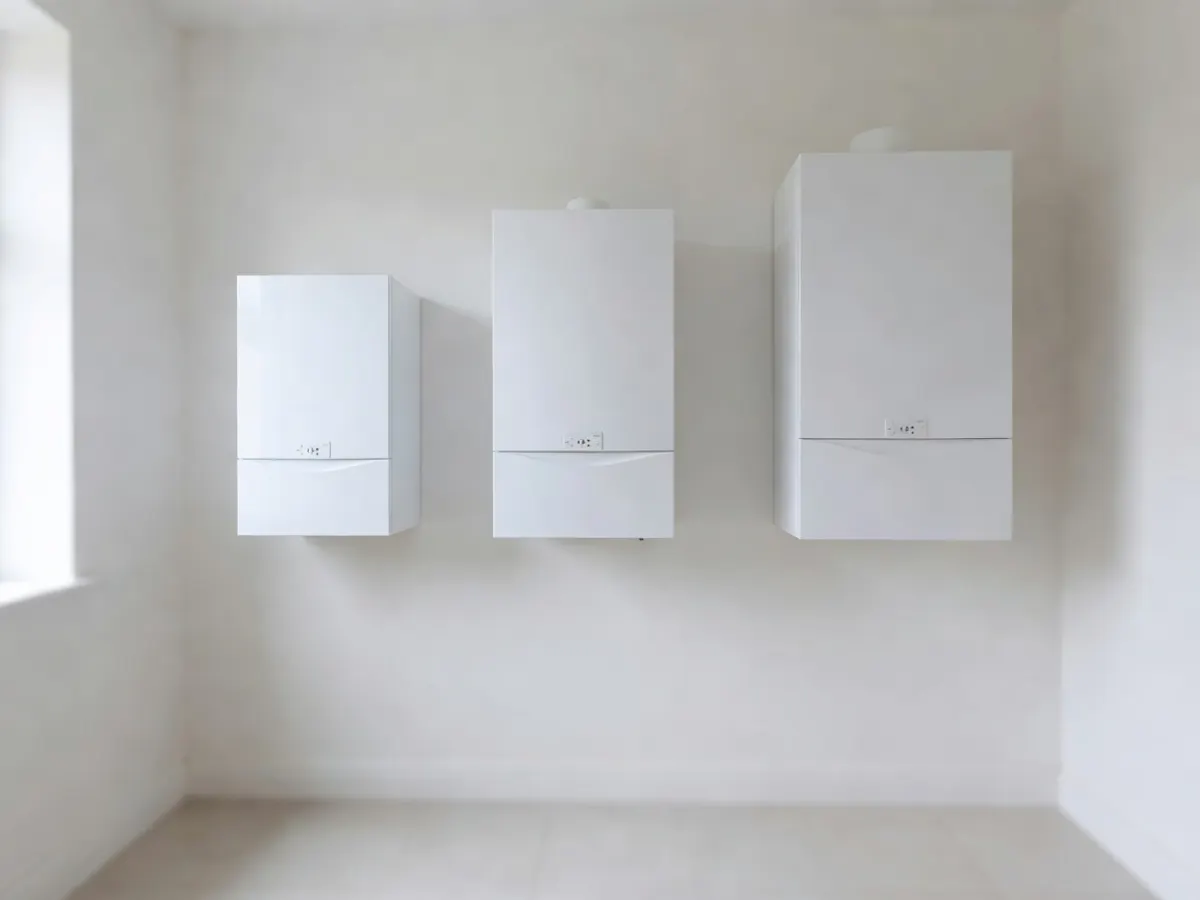
There are three main types of boiler in UK homes: combi, system and regular. What separates them is where your hot water comes from. A combi heats it the moment you turn on a tap, while system and regular boilers draw it from a cylinder the boiler heated earlier.
- Combi boiler: heats water from the mains only when you open a hot tap, so there is no hot water cylinder and nothing in the loft. Scotland's building services guidance refers to hot water "produced instantaneously as by a combination boiler". Read more in our combi boiler guide.
- System boiler: heats your radiators and a hot water cylinder, usually kept in an airing cupboard. The pump and expansion vessel sit inside the boiler casing, so the loft stays empty. See our system boiler guide.
- Regular boiler: also heats a cylinder, but the system is fed by a cold water storage tank and a smaller feed and expansion tank in the loft. Our regular boiler guide covers how that older layout works.
All three are central heating boiler types that run radiators or underfloor heating through a wet central heating system. Older homes may also still have a boiler hidden behind a gas fire; our page on back boiler replacement explains that set-up.
Is a condensing boiler a fourth type of boiler?
No. Condensing is a technology used in all three types, not a separate way of delivering hot water. The term describes how a boiler recovers extra heat from its own flue gases before they leave the house, and the English Housing Survey 2024 to 2025 says condensing boilers have been mandatory for new and replacement boilers since the mid-2000s.
Recovering that heat makes water, which is why a condensing boiler has a small plastic condensate pipe running to a drain.
What type of boiler do I have?
Two places in your home answer it: the airing cupboard and the loft. A quick look at both, plus one test at a tap, is usually enough.
- Check the airing cupboard. A large, usually insulated, hot water cylinder means a system or regular boiler. No cylinder anywhere in the home points to a combi.
- Check the loft. Tanks up there alongside that cylinder mean a regular boiler; an empty loft means a system boiler.
- Run a hot tap with the heating switched off. If the boiler fires up as soon as the tap opens, that fits a combi heating water on demand. With a cylinder, the first hot water comes from the store.
If the clues do not add up, for example after a past conversion left old tanks in place, our engineer confirms the type at the survey.
Which type of boiler suits your home?
For most homes, the simplest replacement is the type the existing pipework already suits, because changing type means adding or taking out a cylinder and tanks. That is extra work on top of the boiler swap, so it pays only when the change gives your household something it needs.
- Keeping a regular boiler makes sense where the loft tanks and older pipework are staying.
- Moving between a combi and a system boiler is the choice most households weigh up, and our guide to combi vs system boilers walks through it.
Homes with no boiler or central heating at all are a different case, covered on our first time central heating page.
Gas, oil, LPG or electric: does the fuel change your choice?
Yes, for the efficiency rules. An oil regular boiler should reach 91% (ErP) and an oil combi 86% (SEDBUK 2009) in both England and Scotland, while gas and LPG boilers of every type share the 92% rule set out below.
- Oil: the regular and combi figures are measured with different methods (ErP and SEDBUK 2009), so the two numbers cannot be compared directly. In Scotland, the guidance says both oil regular and oil combi boilers "should be of the condensing type". For help with the cost of swapping an oil boiler, see our page on oil boiler replacement grants.
- Electric boilers: they burn no fuel in the home. Approved Document L sets no minimum efficiency for them, because electric resistance heating "is assumed to be 100% efficient". The separate ecodesign rules kept in UK law set a seasonal efficiency floor of 36% for electric boilers from 26 September 2017.
Those last two figures measure different things, so neither one tells you what an electric boiler will cost to run.
How efficient must a new boiler be in England and Scotland?
A new gas or LPG boiler of any type in an existing home should reach at least 92% efficiency (ErP) in both England and Scotland. England's rule is in Approved Document L, and Scotland's is in the Domestic Building Services Compliance Guide for Scotland, which the Scottish Technical Handbook points to for boiler standards. Oil boilers follow the figures in the section above.
There is one narrow exception. In exceptional circumstances, an existing home may be allowed a gas boiler of 78% for natural gas or 80% for LPG (SEDBUK 2009). England and Scotland each publish their own guide to the condensing boiler installation assessment procedure, which defines those circumstances, so do not assume the exception applies to your home.
The 2026 edition of Approved Document L applies in England from 24 March 2027 to building work not in connection with higher-risk building work, and it carries the same 92%, 91% and 86% figures. For what these rules add to a quote, see our guide to new boiler cost.
How does a heat pump compare with these boilers?
On paper, a heat pump must clear a higher bar than any boiler. The ecodesign floor is 110% for most heat pumps, against 86% for most gas and oil boilers up to 70 kW, in force since 26 September 2015.
A heat pump is not a boiler. It moves heat from the outside air or the ground into your heating. Our guide to the air source heat pump explains how one fits into a home that has a boiler today, and if you are thinking of taking out a cylinder, read our heat pump cylinder guide first.
If you are worried about being told to remove a working gas boiler, our gas boiler ban guide sets out what the law says and what it does not.
How does FreeBoilerUpgrade.uk choose the right boiler type for you?
We confirm the right type and size after the survey, so you do not need to choose before you speak to us. If approved, you get a new A-rated condensing boiler, and the make and model are confirmed after the survey.
- Eligibility check.
- Survey of your home and current heating.
- Approval.
- Installation by a Gas Safe registered engineer, typically 1 to 2 days on site once approved.
We cover homes in England and Scotland, and we also fit air source heat pumps.
Prefer to talk it through first?
FAQs
What are the three types of boilers?
Combi, system and regular, though a regular boiler is also called a heat-only or conventional boiler, and a system boiler is sometimes called a sealed system boiler. Those extra names are why some lists of boiler types look longer than they are.
What are the five main types of boilers?
There is no single agreed list. Some lists of the different types of boiler add condensing and electric boilers to combi, system and regular, but condensing is a technology and electric is an energy source, not a different way of delivering hot water.
What are the four types of boilers?
Some lists add the storage combi to combi, system and regular. A storage combi is a combi with a small store of hot water built into its casing.
What is the most common boiler in the UK?
In England, the condensing combi. The English Housing Survey found that 63% of homes in England had a condensing combination boiler in 2024 and a further 19% had another kind of condensing boiler. In 2001 the figures were 2% and 1%.
Check If You Qualify
Four quick steps. Tap your answers and we'll do the rest.
Sources
- GOV.UK: English Housing Survey 2024 to 2025, Chapter 2: Energy efficiency
- Approved Document L, Volume 1: Dwellings (2021 edition incorporating 2023 amendments)
- Approved Document L, Volume 1: Dwellings (2026 edition)
- gov.scot: Domestic Building Services Compliance Guide for Scotland (2022 edition)
- gov.scot: Building Standards Technical Handbook, Domestic (April 2026)
- legislation.gov.uk: Commission Regulation (EU) No 813/2013, Annex II (ecodesign requirements) (all checked 16 November 2026)
About This Page
FreeBoilerUpgrade.uk is an installer run by Reliant Energy Solutions Ltd (No. 16100301), incorporated on 25 November 2024. Every boiler is fitted by a Gas Safe registered engineer. We are not part of the government or Ofgem.
- Company: Reliant Energy Solutions Ltd, company number 16100301, address 16 Suite, Turner Business Centre, Middleton, Manchester M24 1RU
- Phone: 07599 995537
- Email: info@freeboilerupgrade.uk
Ready to Start Saving?
See if your household qualifies for funded ECO4 heating upgrades through the ECO4 scheme.
- 100%
- Free Service
- 60s
- Application
- ECO4
- Eligibility check