

Are Heat Pumps Noisy? Noise, Neighbours and Planning Rules
Last updated:
- Typical heat pump noise is 40 to 60 dB, about as loud as a fridge
- To skip planning, a unit must pass the MCS 020(a) sound calculation
- That calculation must come out at 37 dB(A) or less at neighbours' windows and doors
- The old 1 metre boundary rule was removed on 29 May 2025
- Detached houses can now have two units, other homes one
- Listed buildings always need permission for an air source heat pump
Worried about noise or planning before you get a heat pump?
Check If You Qualify- Gas Safe registered engineers
- Company No. 16100301
40 to 60 dB
Typical heat pump noise
Energy Saving Trust
37 dB(A)
Planning sound limit
MCS 020 a)
2 units
Detached house unit limit
SI 2025/560
29 May 2025
Boundary rule removed
SI 2025/560
Are heat pumps noisy enough to matter?
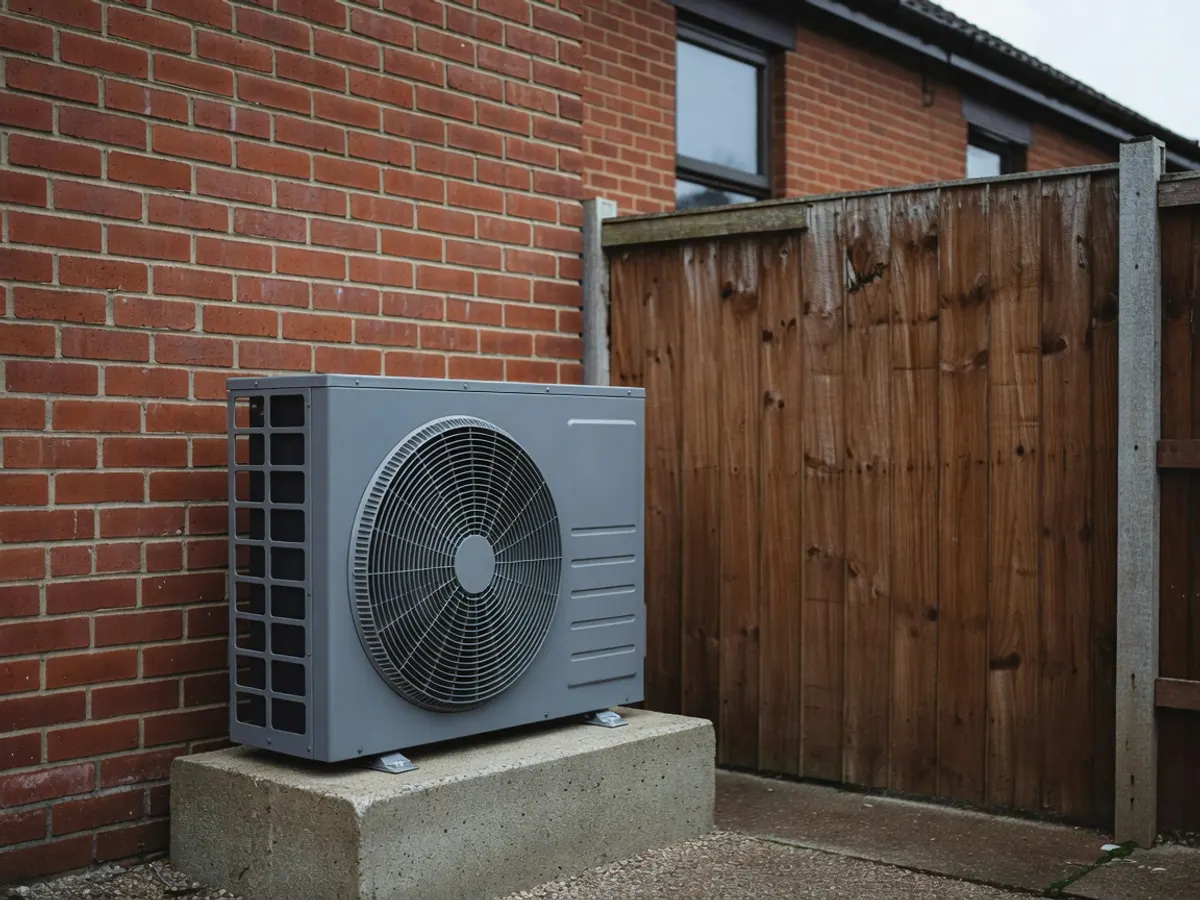
A heat pump is not silent, but noise only becomes a problem when the outdoor unit is in the wrong place or set up badly. Energy Saving Trust puts the typical range of a heat pump when it is on at between 40 and 60 decibels (dB), about as noisy as a refrigerator. Most air source heat pump noise comes from the fan and compressor outside, while heat pump noise inside the house, from parts such as the pump and cylinder, is usually much quieter.
How loud it seems depends on the model, how hard it is working and where it sits. On a cold day the unit may work harder and sound a little louder, though Energy Saving Trust says you can still have a normal conversation standing right next to one. A unit with walls close around it is heard more than one on an open wall, because sound bounces off hard surfaces.
Planning law in England builds noise into the decision on where a unit can go, so the noise question and the planning question are answered by the same check.
The sound check every unit has to pass
An air source heat pump only counts as permitted development in England if it complies with the MCS Planning Standards. The planning rules define those as "MCS 020 a) - Air Source Heat Pump Sound Calculation (For Permitted Development Installations)".
The calculation works out the sound level at an assessment position 1 metre outside the centre of each door or window to a habitable room, such as a living room or bedroom, in neighbouring homes. To count as permitted development, the calculated result must be 37 dB(A) or less at every one of those positions. MCS 020 a) starts from the manufacturer's A-weighted sound power level for the model and adjusts for the distance to the neighbour's window and the position of the unit, so the 37 dB(A) is a calculated level at the window, not the sound of the unit itself.
If a position fails, the unit has to move, a quieter model is needed, or the job needs planning permission. The closest window is not always the loudest position, because walls and other surfaces near the unit change the result.
Do you need planning permission for an air source heat pump?
In England, you do not need a planning application when the unit meets every limit in Part 14, Class G of the planning order. Miss any one limit and the install needs planning permission instead.
Status, checked 12 November 2026: legislation.gov.uk shows Class G as amended by SI 2025/560 from 29 May 2025; these are the rules for England.
Under the current rules, the install is not permitted development if:
- The home already has its limit of units. A detached house can have up to two air source heat pumps. Any other house, and any block of flats, can have one.
- The outdoor unit is too big. Its volume, including any housing, must not exceed 1.5 cubic metres on a house or 0.6 cubic metres on a block of flats.
- It goes on a pitched roof, or on a flat roof within 1 metre of the roof's outer edge.
- The building is listed, or the site is a scheduled monument.
- The home is in a conservation area or World Heritage Site and the unit would be on a wall or roof facing a road, or nearer to a road than the house itself.
- Elsewhere, it is above the ground floor on a wall that faces a road.
- There is already a wind turbine on the building or in the grounds.
The unit must also not be used only for cooling, must be placed so far as practicable to limit its effect on how the building looks and on the area around it, and must be removed when it is no longer needed.
Some homes have lost these rights altogether. GOV.UK's planning guidance says permitted development rights can be removed by the local planning authority through a condition on a planning permission or through an article 4 direction.
What changed in the heat pump planning rules in 2025?
The heat pump planning permission rules were relaxed from 29 May 2025 by the Town and Country Planning (General Permitted Development) (England) (Amendment) Order 2025. For many terraced and semi-detached homes, the most useful change is that the unit no longer has to sit at least 1 metre from the boundary.
| Rule | Before 29 May 2025 | From 29 May 2025 |
|---|---|---|
| Distance from the boundary | No part within 1 metre of the boundary | Rule removed |
| Number of units | One per home, on the building or in its grounds | Two on a detached house, one on other homes |
| Outdoor unit size | 0.6 cubic metres | 1.5 cubic metres on a house, 0.6 on a block of flats |
| Noise standard | MCS 007 or equivalent standards | MCS 020(a) only, after a transition that ended on 28 May 2026 |
| Use | Heating only | Must not be used only for cooling |
The changes are in SI 2025/560, which amended Class G and the definition of the MCS Planning Standards in the 2015 planning order. With the 1 metre rule gone, a unit can sit close to a shared fence, so the sound calculation does more of the work of protecting neighbours.
Are heat pumps noisy for neighbours?
A unit that passes the sound calculation is less likely to disturb a neighbour, but it can still be heard, and a council can still look into a complaint. Neighbours hear the outdoor unit, so the side of the house it sits on matters more than anything inside.
If heat pump noise does disturb someone, it is treated like other noise from a home. GOV.UK explains that councils in England must look into noise that could be a statutory nuisance under the Environmental Protection Act 1990, meaning noise that unreasonably and substantially interferes with the use or enjoyment of a home, or injures health or is likely to. Where a council agrees, it must serve an abatement notice requiring the noise to stop or be restricted.
Councils also have a night-time power. Between 11pm and 7am they can issue warning notices for noise above set levels, measured inside the home of the person complaining:
- 34 dBA where the background noise is no more than 24 dBA
- 10 dBA above the background level where the background is more than 24 dBA
These levels apply to noise from a home or other premises, not to heat pumps in particular. They explain why a quieter night setting can be worth asking for.
Where the outdoor unit should go to keep noise down
The best spot balances the sound calculation, airflow around the unit and a short pipe run to the house. A few things to look at in your own garden or yard:
- Open space around the unit. Fewer hard surfaces close by means less sound bounced back.
- A solid, level base. Anti-vibration mounts help stop vibration passing into the walls.
- Room to breathe. The unit needs free airflow, so it cannot be boxed in tightly.
- Access for servicing. The engineer needs to reach the unit and its pipework.
A purpose-made acoustic enclosure approved for the model can cut noise, but it must not block airflow, and planning law counts any housing in the 1.5 cubic metre volume limit.
Our heat pump installation guide shows how the rest of the job runs.
How we help with noise and planning
FreeBoilerUpgrade.uk offers air source heat pumps across England and Scotland, and helps with the Boiler Upgrade Scheme for homes in England. At the survey we look at where a unit could sit and flag anything that may need a closer look, such as a listed building, a conservation area or a tight space near a neighbour.
If you are still deciding whether a heat pump suits your home at all, our guide on whether heat pumps are worth it covers the cost and comfort side.
FAQs
What is the noise level of a heat pump?
Energy Saving Trust puts the typical range of a heat pump when it is on at between 40 and 60 dB, about as noisy as a refrigerator. The exact level depends on the model and how hard it is running. Manufacturers publish sound data for each model, usually as a sound power level, and that figure is what the installer feeds into the planning calculation. Ask to see the result for the model you are offered.
Why is my new heat pump so loud?
A new heat pump that seems loud may be working hard, set with a high fan speed, or not level. Energy Saving Trust says louder-than-expected noise is often because the unit needs a service or has not been levelled correctly, and anti-vibration feet can help. In cold, damp weather the outdoor unit may also run a short defrost cycle, which can change its sound for a few minutes. The installer can check the settings and the mounting.
Are heat pumps noisy at night?
They can run at night, when the background is quieter and any sound is easier to notice. Some models have a low noise or night mode that limits fan speed, which can be set up at handover.
How do you block noise from a neighbour's heat pump?
The quickest step is usually a conversation, because the owner's installer may be able to lower the fan speed at night or fix a vibrating mount. Moving the unit or adding a barrier is a bigger job for the owner.
Do the same planning rules apply in Scotland?
No. The rules on this page are England's permitted development rules, and MCS said when the English rules changed in May 2025 that installations in Scotland, Wales and Northern Ireland must continue to follow the earlier MCS 020 standard until further notice.
Check If You Qualify
Four quick steps. Tap your answers and we'll do the rest.
Sources
- legislation.gov.uk: The Town and Country Planning (General Permitted Development) (England) Order 2015, Schedule 2, Part 14
- legislation.gov.uk: SI 2025/560, the 2025 amendment order
- GOV.UK: When is permission required?
- GOV.UK: Noise nuisances, how councils deal with complaints
- MCS 020 a) Air Source Heat Pump Sound Calculation, Issue 1.1, MCS: New Permitted Development rules in England, air source heat pump installations must now comply with MCS 020 a), Energy Saving Trust: heat pump guide (all checked 12 November 2026)
About This Page
FreeBoilerUpgrade.uk is an installer run by Reliant Energy Solutions Ltd (No. 16100301), incorporated on 25 November 2024. Every boiler is fitted by a Gas Safe registered engineer. We are not part of the government or Ofgem.
- Company: Reliant Energy Solutions Ltd, company number 16100301, address 16 Suite, Turner Business Centre, Middleton, Manchester M24 1RU
- Phone: 07599 995537
- Email: info@freeboilerupgrade.uk
Ready to check the best spot for a heat pump at your home?
Ready to Start Saving?
See if your household qualifies for funded ECO4 heating upgrades through the ECO4 scheme.
- 100%
- Free Service
- 60s
- Application
- ECO4
- Eligibility check