
Back Boiler Replacement: Which Grants Still Pay and What the Work Involves
Last updated:
- No grant pays just because you have a back boiler
- In England, the Boiler Upgrade Scheme grant for an air-to-water heat pump is £7,500
- Warm Homes: Local Grant never funds a new gas boiler
- Scotland's Warmer Homes Scotland can fund new gas boilers
- A new gas boiler in an existing home should reach 92% efficiency
- Never light a fire in front of an old, sealed back boiler
Not sure which grant covers your fireplace?
Check If You Qualify- Gas Safe registered engineers
- Company No. 16100301
£7,500
Air-to-water heat pump grant
GOV.UK notice of grant values
Below £36,000
Local Grant income pathway
DESNZ policy guidance
92%
New gas boiler, existing home
Approved Document L
Above 700°C
Solid fuel back boiler, no water
HSE safety alert
Can you still get a grant for back boiler replacement?
Yes, but any back boiler replacement grant depends on what replaces the back boiler and where you live, not on the back boiler itself. In England, the main help for back boiler replacement is the Boiler Upgrade Scheme, which cuts £7,500 from the price of an air-to-water heat pump; the Warm Homes: Local Grant can pay for low carbon heating in lower income homes, and in Scotland Warmer Homes Scotland can pay for a new gas boiler.
None of the scheme rules checked for this page lists a back boiler as a reason to qualify, so there is no separate back boiler grant or back boiler removal grant. What counts is your household, how the home scores on its energy certificate and the heating you pick next. Here is how each route treats a back boiler swap, checked on 16 November 2026:
- Boiler Upgrade Scheme (England and Wales): the GOV.UK notice of grant values, effective from 21 July 2026, sets £7,500 for an air-to-water heat pump in a home that is not off the gas grid. In an off-gas home replacing a coal heating system, an air-to-water heat pump also gets £7,500 and a biomass boiler gets £5,000. It never pays for a gas boiler. Our Boiler Upgrade Scheme guide covers the rules in full.
- Warm Homes: Local Grant (England only): the DESNZ policy guidance covers homes rated EPC D to G, with three household pathways, one of them an annual gross income below £36,000. Owner occupiers are not expected to contribute, and the delivery window closes on 31 March 2028. It states that heating systems fuelled by fossil fuels are not eligible, so it cannot put a gas boiler where your back boiler was. See who the Warm Homes: Local Grant helps.
- Warmer Homes Scotland: the Scottish Government scheme can fund central heating, including new gas boilers or air source heat pumps, and mygov.scot says the government will usually meet all the costs. Homeowners and private tenants qualify through the household (for example, certain benefits, or a person aged over 75 without working central heating) and through the home, and the programme is delivered by Warmworks. Our page on boiler grants in Scotland sets out the other options there.
What is a back boiler, and is there one behind your fire?
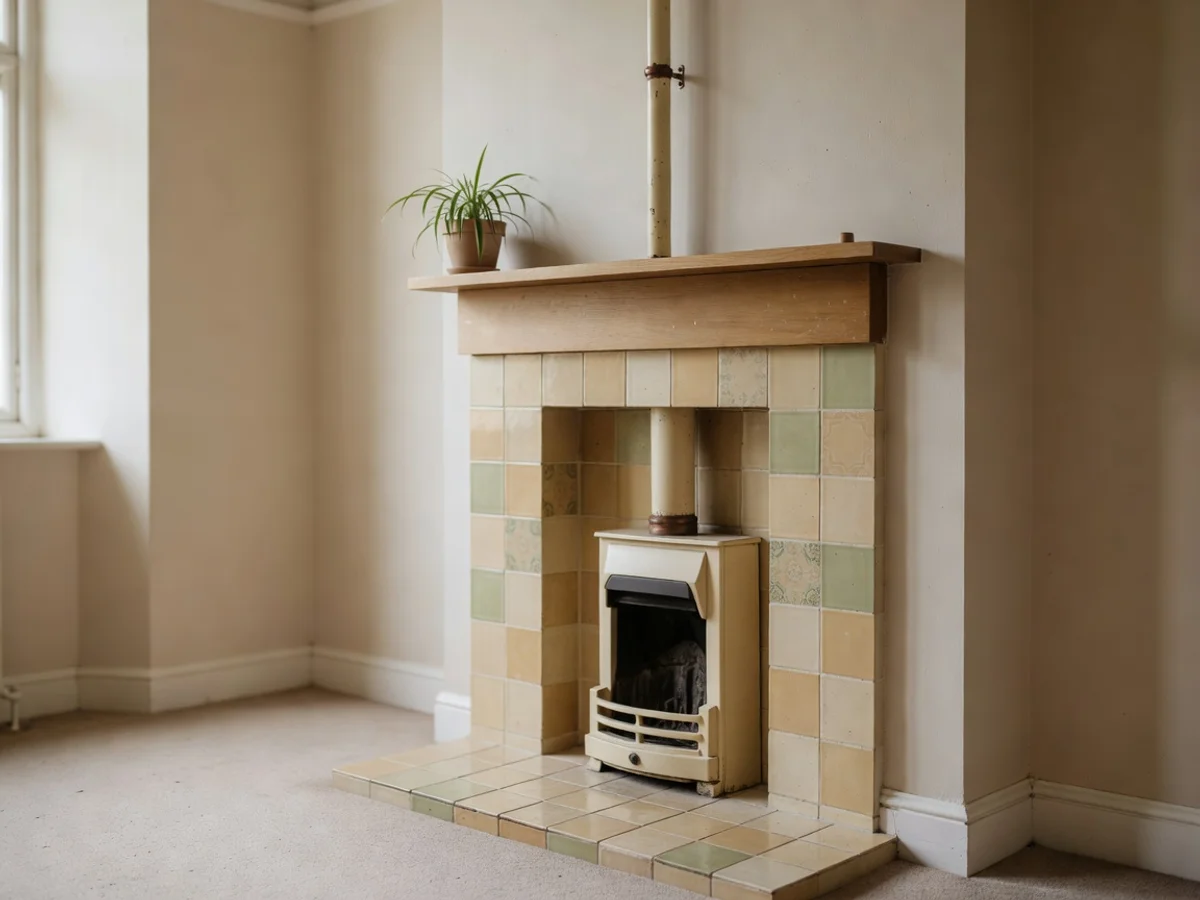
A back boiler is a boiler built into the fireplace, sitting behind a gas fire or an open coal or wood fire, and heating your radiators and hot water from there. Approved Document L calls the gas version a "combined fire and back boiler unit", and Approved Document J covers gas back boilers fitted in a fireplace recess.
Three clues usually give one away:
- Pipes lead into the fireplace. Heating pipework running into the fireplace or the chimney breast points to a water heater sitting behind the fire.
- There is no boiler anywhere else. No kitchen or cupboard boiler, yet the radiators heat up.
- A tank and a cylinder. A hot water cylinder in the airing cupboard and a cold water tank in the loft show an older open-vented system, the kind a back boiler often feeds.
For a solid fuel back boiler, the Health and Safety Executive describes the unit as a fire grate with a water chamber surrounding it, generally behind the fire but sometimes at the sides and partly above the grate. If your fireplace only warms one radiator, or none, your home may count as having no central heating at all, and our first time central heating grant guide covers that case.
What happens to the fireplace when the back boiler comes out?
The boiler leaves the chimney, the new heat source goes somewhere else in the home, and you decide whether the fireplace stays usable, gets a new fire or is closed off.
What the work usually covers:
- Draining the system and disconnecting the old boiler, gas supply and pipework.
- Back boiler removal from the fireplace. HSE guidance says the redundant pipework should be removed along with, ideally, the back boiler itself.
- Fitting the new heat source in a new spot, with its own flue route. If you change to a combi, the loft tank and cylinder can often go, because a combi boiler heats water as you run the tap.
- Sorting out the fireplace. If you want to keep using an open fire, HETAS advice quoted by the HSE says a replacement Milner fire back needs to be installed so the fire can be used safely.
- Paperwork. In England this is building work that needs approval. GOV.UK says a fitter registered with a competent person scheme takes care of it, so you do not apply for it yourself.
Check for asbestos before anything is broken out. The HSE says asbestos may be part of any home built or refurbished before 2000, and lists lagging on pipes and boilers and asbestos cement flues among the places it is still found. It also says not to repair or remove asbestos materials yourself without training for non-licensed asbestos work.
At FreeBoilerUpgrade.uk, the survey looks at your current heating before anything is quoted, and every boiler is fitted by a Gas Safe registered engineer. The HSE's domestic gas guidance says paid gas work in a home must be done by a Gas Safe registered engineer who is competent for that type of work, and that the engineer's competencies are marked on the back of their ID card.
Old back boiler still in the chimney? Read this before you light a fire
Do not light a fire in front of a back boiler that was left behind when the heating was changed. The HSE issued a safety alert after redundant solid fuel back boilers, sealed up and left in the fireplace, exploded when a coal or wood fire was lit in front of them. The alert records several incidents, three with serious injury and one death.
The risk comes from water left inside. Old units are hard to drain completely, and any water left in a sealed boiler turns to steam when heated. In tests cited by the HSE, the top and sides of a solid fuel back boiler without circulating water reached temperatures above 700°C.
The alert sets out the industry advice for an old unit left in place:
- A redundant back boiler left in place must not be able to build up pressure. If it was not removed, it should have been left vented or open, with at least one 6mm hole drilled in the water jacket where the pipe connections were plugged.
- Pipework left connected can let flue gases travel to other rooms if the water jacket corrodes or cracks, and the hot pipes can be a fire risk.
- The flue of a gas fire fitted later must not pass through the old water jacket.
Some of these units were left in place after a home switched to a new boiler elsewhere, often hidden behind a panel or kept for the look of the grate. If that sounds like your living room and you are not sure how it was decommissioned, keep the fireplace out of use until it has been checked.
Carbon monoxide is the other hazard. The HSE says it can come from any combustion appliance, including ones burning wood and coal, and lists warning signs such as flames burning yellow or orange rather than blue (fuel effect fires excepted), soot or yellow or brown staining around an appliance, pilot lights that keep blowing out and more condensation inside windows.
What do today's Building Regulations say about back boilers?
England's Approved Documents still set standards that cover back boilers. Approved Document L, Volume 1 (2021 edition incorporating 2023 amendments), sets a minimum of 45% for natural gas for an inset live fuel-effect combined fire and back boiler, and says a gas fire that is part of a combined fire and back boiler unit in an existing system should meet BS 7977-2.
Approved Document J (2022) still includes a section on bases for back boilers, which "should adequately protect the fabric of the building from heat", and allows flexible flue liners to connect gas back boilers to chimneys.
For a modern replacement, the same Approved Document L sets 92% (as defined in ErP) for gas wet heating with radiators in an existing home, with lower SEDBUK figures of 78% for natural gas allowed only in exceptional circumstances. The two figures come from different test methods, so they are not a like-for-like comparison.
What does back boiler replacement cost if you pay yourself?
At FreeBoilerUpgrade.uk, back boiler replacement is £3,500 to £6,000 for private payers (guide range), confirmed in writing after a free survey. No government body publishes an official price for replacing a back boiler.
Where your job lands in that range comes down to the parts a normal boiler swap does not have:
- The new position. Moving the heat source out of the chimney means new pipe runs and a new flue route.
- The old water system. Taking out the loft tank and the cylinder for a combi, or keeping them for a system that still uses a cylinder.
- What is left in the fireplace. A new fire, an open fire made safe to use again, or closing it off.
For VAT, finance and the general items that push any boiler quote up or down, see our guide to new boiler cost. If a heat pump is the route you take and the grant does not cover the whole price, our page on heat pump finance explains the options.
FAQs
Is it a big job to remove a back boiler?
Yes, bigger than a like-for-like swap, and the survey is where its size is settled. How far the new heat source sits from the old pipework, what is found behind the fire and whether you keep the fireplace all change how much work is involved.
What should I replace my back boiler with?
For most homes on the gas grid, the choice is a condensing gas boiler or a heat pump. There is a middle option too: the Warm Homes: Local Grant guidance allows a hybrid heat pump in a home currently heated by mains gas, though only the heat pump part can be funded.
Are back boilers dangerous?
For a back boiler still in use, the HSE advises that coal and wood appliances are serviced by a competent person and the chimney is swept regularly. If you rent, the Smoke and Carbon Monoxide Alarm (Amendment) Regulations 2022 mean that in England, since 1 October 2022, relevant landlords must provide a carbon monoxide alarm in any room used as living accommodation that contains a fixed combustion appliance (gas cookers excluded).
Are there any boiler grants available in 2026?
Yes. The GOV.UK government response confirms that ECO4, the energy supplier scheme, closes on 31 December 2026, so for a back boiler home the routes in the first section of this page are the ones to plan around. Our boiler replacement schemes page sets out the schemes we can help with, with their dates.
Ready to plan your back boiler replacement?
Check If You Qualify
Four quick steps. Tap your answers and we'll do the rest.
Sources
- GOV.UK: Notice of approved grant categories and values for the Boiler Upgrade Scheme
- DESNZ: Warm Homes: Local Grant policy guidance (updated June 2026)
- Approved Document L, Volume 1: Dwellings (2021 edition incorporating 2023 amendments)
- Approved Document J (2022)
- HSE: Risks from redundant solid fuel back boilers (safety alert)
- HSE: Asbestos FAQs
- HSE: Carbon monoxide awareness FAQs
- HSE: Domestic gas safety FAQs
- GOV.UK: Building regulations approval
- mygov.scot: Warmer Homes Scotland scheme
- GOV.UK: Extending the ECO4 end date (government response)
- legislation.gov.uk: The Smoke and Carbon Monoxide Alarm (Amendment) Regulations 2022 (all checked 16 November 2026)
About This Page
FreeBoilerUpgrade.uk is an installer run by Reliant Energy Solutions Ltd (No. 16100301), incorporated on 25 November 2024. Every boiler is fitted by a Gas Safe registered engineer. We are not part of the government or Ofgem.
- Company: Reliant Energy Solutions Ltd, company number 16100301, address 16 Suite, Turner Business Centre, Middleton, Manchester M24 1RU
- Phone: 07599 995537
- Email: info@freeboilerupgrade.uk
Ready to Start Saving?
See if your household qualifies for funded ECO4 heating upgrades through the ECO4 scheme.
- 100%
- Free Service
- 60s
- Application
- ECO4
- Eligibility check