
Loft Insulation Grant: Measure Your Loft, Then See Who Pays
Last updated:
- ECO4 can still fund loft insulation for work finished by 31 December 2026
- A loft with more than 100mm already in it is not automatically ruled out
- Pension Credit, a council income route or a health referral can open the door
- In England, the Warm Homes: Local Grant pays for loft insulation on a household income usually up to £36,000
Find out if your loft qualifies
Check If You Qualify- Gas Safe registered engineers
- Company No. 16100301
31 Dec 2026
ECO4 end date
Ofgem
£36,000
Local Grant income
GOV.UK, usually
270mm
Recommended depth
Energy Saving Trust
Closed
GBIS
Ofgem, 31 Mar 2026
Is There Still a Loft Insulation Grant in 2026?
Yes. A loft insulation grant is still available on 5 November 2026 through two funded routes. ECO4 covers England and Scotland for work completed by 31 December 2026, and councils in England run the Warm Homes: Local Grant until March 2028. The Great British Insulation Scheme closed on 31 March 2026.
Status, checked 5 November 2026: ECO4 work must be finished by 31 December 2026 · GBIS closed to new installations · Warm Homes: Local Grant delivery window closes 31 March 2028 · We survey and fit in England and Scotland
A loft that already has some insulation in it is the usual reason people expect a refusal. Depth matters less than who lives in the home, its energy rating and what else the home needs. Measure first, because that number shapes every route below.
How Deep Is Your Loft Insulation? A Five-Minute Check
Current building regulations recommend at least 270mm of mineral wool, the Energy Saving Trust says. Anything well below that is worth topping up, whether or not a grant pays.
You need a torch, a tape measure or ruler and your phone. Only go up if the hatch is safe to reach and the joists can take your weight. Never stand between the joists on the ceiling itself.
- From the hatch, look across the loft. If you can see the tops of the wooden joists, the insulation is no deeper than the joists.
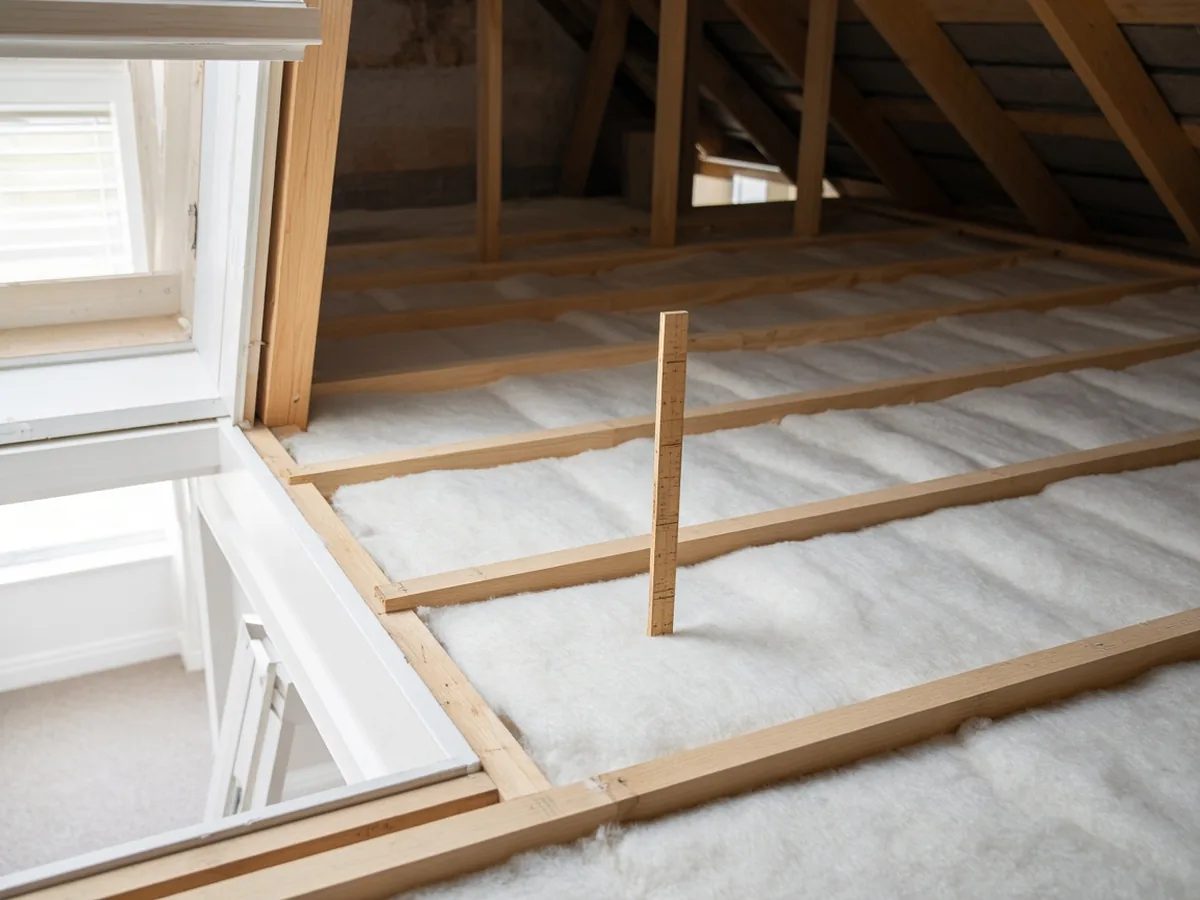
- Push the ruler down through the insulation until it touches the ceiling board, without squashing the material.
- Measure in three or four places: near the hatch, in the middle and close to the eaves. Lofts are often thinner at the edges.
- Note any bare patches, boards laid over the joists, or water tanks and pipes left uncovered.
Take four photos while you are there:
- the ruler standing in the insulation, with the number readable
- a wide shot of the whole loft floor
- any boarded area, from above
- the hatch, open, so the size of the opening shows
Those photos save time at the survey. They also help if you send your details to our team on WhatsApp first.
What your measurement means
- No insulation, or 100mm and under: the classic case for funding. ECO4 records this as its own loft measure.
- More than 100mm but short of 270mm: still a top-up job. ECO4 has a separate measure for lofts above 100mm, so this alone does not rule you out.
- 270mm or more across the whole loft: the loft is done. Funding is then about other parts of the home, such as walls or heating.
- Used as a room: the survey checks whether it counts as a room-in-roof under Ofgem's wall-height test, which is a different measure.
- Boarded for storage: tell the surveyor, because the boards change how the insulation goes in.
Which Schemes Pay for Loft Insulation Now
Two schemes are open for loft work on 5 November 2026, and each has its own test. ECO4 looks at benefits or a council declaration, while the Local Grant looks mainly at income or postcode.
| Route | Who it suits | Home rating needed | Where | Status, 5 Nov 2026 |
|---|---|---|---|---|
| ECO4, benefits route | Someone in the home gets a qualifying benefit such as Universal Credit or Pension Credit | D to G if you own it, E to G if you rent privately | England and Scotland | Open for work completed by 31 December 2026 |
| ECO4 Flex, Route 1 (income) | Gross household income under £31,000, no benefit needed | D to G owned, E to G rented | England and Scotland | Same end date as ECO4 |
| ECO4 Flex, Route 2 (two proxies) | Two signs of fuel poverty or vulnerability, such as age 65 or over plus a low-income Council Tax Reduction | E to G only | England and Scotland | Same end date as ECO4 |
| ECO4 Flex, Route 3 (health referral) | A GP or NHS referral for a condition made worse by the cold; no income test | D to G owned, E to G rented | England and Scotland | Same end date as ECO4 |
| Warm Homes: Local Grant | Household income usually £36,000 or less, a listed postcode, or certain benefits | D to G | England only | Delivery window closes 31 March 2028 |
| Great British Insulation Scheme | Was the main single-measure insulation scheme | Not applicable | Great Britain | Closed on 31 March 2026 |
The full rules for the council routes sit on our LA Flex scheme page. For how ECO4 itself works, from supplier funding to the end date, read our guide to the ECO4 scheme.
Three ECO4 rules that catch people out
ECO4 is a whole-home scheme, not a loft-only grant. The project has to lift the home's energy rating, to at least band C from D or E, or to at least band D from F or G. If a loft top-up alone cannot reach that rating, it goes in alongside wall insulation or a heating upgrade.
Before ECO4 funds new heating in an E, F or G home, the loft and cavity walls must already be insulated, which is why loft work often comes first on a first time central heating grants job.
Privately rented homes need a bigger measure in the package. A rental on ECO4 must receive at least one of solid wall insulation, first time central heating, renewable heating or a district heating connection. A loft alone is not enough there.
If your loft was insulated under an earlier ECO scheme while you already owned the home, Ofgem will reject a new loft claim. If you bought the home after that work, it can be looked at again.
Not sure which row fits your home?
Loft Insulation Grant for Pensioners
A loft insulation grant for pensioners depends on benefits, income or health, never on age by itself. Being 70 or 80 does not qualify a home, but several routes suit older households well.
- Pension Credit: both Guarantee Credit and Savings Credit are on the government's ECO4 benefit list. This is the most direct way in.
- Age plus one other sign: under ECO4 Flex Route 2, being 65 or over counts as one proxy. Your council needs a second one, such as a low-income Council Tax Reduction, and the home must be rated E, F or G.
- Income under £31,000: a pensioner living on a State Pension and a small private pension may fall under the Flex Route 1 cap, with savings themselves not counted as income (only what they earn, such as interest).
- A health condition: a GP or NHS referral under Route 3 has no income test at all.
- In England, the Local Grant: a pension household with income usually up to £36,000 can be eligible, subject to council funding.
Older readers often want a new boiler at the same time. Our page on free boilers for pensioners covers that side, including what happens to heating once the loft is done.
Free Loft Insulation If You Are Not on Benefits
Yes, you can get free loft insulation if you are not on benefits, but only through an income, health or postcode route. Each one has its own paperwork.
- Council income route (ECO4 Flex Route 1): the gross income of every adult living in the home must add up to less than £31,000 a year. Payslips, pension statements or a P60 usually show this.
- Health referral (ECO4 Flex Route 3): a GP or NHS referral for someone whose cardiovascular condition, respiratory disease, limited mobility or immunosuppression is made worse by a cold home.
- Warm Homes: Local Grant (England): pays for wall, loft and underfloor insulation where household income is usually £36,000 or less, or where you live in one of the government's listed postcode areas. We help with the application, from the form to the documents.
The Local Grant has more time left than ECO4, so it is often the better fit for a household that cannot be ready before the end of December. Our guide to the Warm Homes: Local Grant explains the income tables and postcode route in detail.
If you are working out a wider plan without benefits, our page on getting a boiler grant if you're not on benefits sets out the heating side.
What Happens on Survey and Fitting Day
A funded loft job starts with a survey of the whole home, not only the loft. Ofgem says ECO4's multiple-measure approach aligns with the whole-house approach in PAS 2035:2023, so expect the survey to cover walls and heating as well.
Our process runs in four stages:
- Eligibility check: we confirm your benefit, income or council route and your home's energy rating.
- Survey: the surveyor looks at the existing depth, damp, ventilation, the water tank and pipes, the hatch and any boarding.
- Approval: the funding is confirmed for your home before any work starts.
- Installation: the work is fitted, and approved homes pay nothing for the funded measures. Any extras are agreed with you in writing first.
The loft declaration
Before any loft work under ECO4, the installer and the occupier (or the landlord) sign a pre-existing loft insulation declaration. It records what was in the loft beforehand.
A copy is then fixed in the loft, close to the hatch, for example on a nearby rafter. Please leave it there. The supplier keeps a copy or photo, and Ofgem can ask to see it if it has concerns.
Have these ready
- proof of your benefit, or income evidence for every adult in the home
- something showing your address, such as a recent council tax or utility bill
- the owner's written permission if you rent
- your loft photos
Clear stored boxes away from the hatch area before the survey if you can. It helps the surveyor see the joists and measure properly. How long the whole process takes depends on your paperwork and the survey.
Loft work often goes in alongside wall insulation, which our page on cavity wall insulation grants covers. For every other measure, from solid walls to floors, see our hub on insulation grants.
Ready to have your home looked at properly?
Paying for It Yourself: Cost, VAT and Savings
If no route fits, the Energy Saving Trust puts a professional install at about £750 for an empty loft and about £600 to top up from 120mm to 270mm. Those are its Great Britain figures, on a page last updated on 8 May 2026.
The VAT point most guides skip
- Fitted by a business: installing loft insulation in a home is zero-rated for VAT from 1 May 2023 to 31 March 2027. From 1 April 2027 it returns to the reduced rate of 5%.
- Bought to fit yourself: HMRC says energy-saving materials sold by a retailer without installation are always standard-rated. DIY rolls carry normal VAT.
So the gap between paying a professional and doing it yourself is smaller than the shelf price of the rolls suggests, at least until the end of March 2027.
When DIY makes sense
The Energy Saving Trust says DIY is fine when the loft is easy to reach, has no damp and is not a flat roof. The usual method is two layers of mineral wool: the first between the joists, the second laid at right angles across them to build up the depth.
Bring in a professional if any of these apply:
- you have a flat roof, or want the insulation at the sloping rafters
- the loft is used as a room
- there are signs of damp, condensation or structural problems
The Trust also lists the water tank, the pipes and the loft hatch as things to plan for when you insulate, along with ventilation and any storage boarding.
What you save
An uninsulated roof loses around a quarter of a home's heat, according to the Energy Saving Trust, and loft insulation lasts around 40 years. That is why the Trust calls loft insulation cost-effective: it should pay for itself many times over.
Going from 120mm to 270mm saves around £17 a year in Great Britain on the Trust's figures. If your loft is already half full, the stronger reasons to finish it are comfort and getting the home ready for a heat pump, not a fast return.
Common Questions
Do energy companies like British Gas still give free loft insulation?
Not through their own sign-ups. British Gas's ECO page, checked on 5 November 2026, says applications for its ECO and GBIS schemes are closed. ECO4 itself is still open for work completed by 31 December 2026, through installers like us who submit the work under the scheme.
Can I get free loft insulation if I rent?
Yes, with your landlord's permission, but the route matters. Under ECO4 a private rental must be rated E to G and needs a bigger measure in the package, such as first time central heating. Under the Local Grant in England, the landlord may have to pay part of the cost. Our free boiler for tenants guide covers the conversation with your landlord.
Is a loft conversion covered by a loft insulation grant?
It can be, but as room-in-roof insulation rather than standard loft insulation. Ofgem treats a loft conversion or dormer bungalow as a room-in-roof when the low wall is under 1.8 metres high for at least half its length. The survey decides which one applies.
Someone called offering a free loft insulation grant. Is it real?
It might be, but check before you let anyone in. Never pay anyone to "release" a grant. Approved homes pay nothing for funded ECO4 work. Our guide to ECO4 grant scams lists the warning signs.
What if I am unhappy with insulation fitted under ECO4?
Ofgem's complaints order starts with the TrustMark complaints process where it applies. If it does not, the complaint goes to the installer, then the guarantee provider, then the scheme or certification body, and finally an ombudsman.
ECO4 closes on 31 December 2026. Find out where your loft stands.
Check If You Qualify
Four quick steps. Tap your answers and we'll do the rest.
Sources
- Ofgem, Energy Company Obligation (ECO)
- Ofgem, ECO4 Delivery Guidance version 4.0
- GOV.UK, Apply for the Warm Homes: Local Grant
- Ofgem, Great British Insulation Scheme
- HMRC VAT Notice 708/6, Energy-saving materials and heating equipment (GOV.UK)
- DESNZ Warm Homes: Local Grant Policy Guidance, July 2026
- Ofgem, GBIS and ECO4 Local Authority Administration Guidance v3.0
- Energy Saving Trust, Roof and loft insulation guide
- British Gas ECO scheme page
About This Page
FreeBoilerUpgrade.uk is an installer run by Reliant Energy Solutions Ltd (No. 16100301), incorporated on 25 November 2024. Every boiler is fitted by a Gas Safe registered engineer. We are not part of the government or Ofgem.
- Company: Reliant Energy Solutions Ltd, company number 16100301, address 16 Suite, Turner Business Centre, Middleton, Manchester M24 1RU
- Phone: 07599 995537
- Email: info@freeboilerupgrade.uk
Ready to Start Saving?
See if your household qualifies for funded ECO4 heating upgrades through the ECO4 scheme.
- 100%
- Free Service
- 60s
- Application
- ECO4
- Eligibility check